
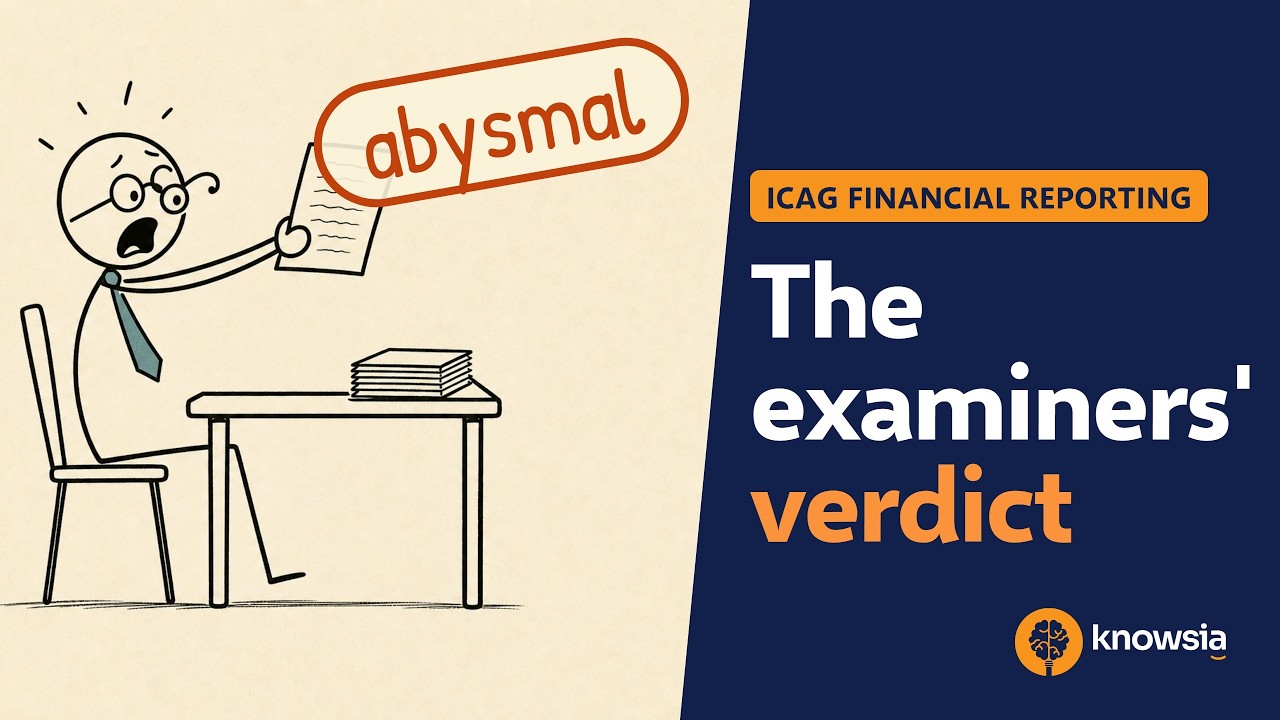
In May 2021, only 10.54% of candidates passed ICAG Financial Reporting. Nearly nine in ten failed. In November 2020, the pass rate was 23%.
If you studied for months and still failed, you are not alone — and the reason may not be how many hours you put in.
After every sitting, ICAG's Chief Examiner publishes a report on how candidates performed and where they lost marks. We read the Financial Reporting reports from May 2018 to August 2022. (If you are new to how the papers are set and passed, start with ICAG assessments: format, pass marks and progression rules.) Sometimes the examiners fault the paper itself: one report said some questions "were too much loaded requiring more time and the marks allocated were not commensurate with the volume of work." But the same mistakes come back sitting after sitting, and most of them are within your control.
Here are seven of them, in the examiners' own words, with a fix for each.
▶ Watch the video on YouTube — the seven mistakes, drawn and explained in five minutes
1. Knowing a standard's name, not what it requires
The examiners' word for candidates' knowledge of IFRS: "abysmal." Most candidates, they wrote, "either did not attempt questions on IFRSs or provided answers with no bearing on IFRSs."
The same reports point the other way too: "Candidates with high understanding of the Accounting Standards scored high marks." Same paper, different preparation.
The fix. For every standard on your syllabus, be able to say three things:
- What it requires — the recognition, measurement and disclosure rules.
- When it applies — the transactions and situations it covers.
- How it works on an exam question — applied to a scenario, not recited.
Then attempt a past question, and hold your working next to the examiner's answer — why practising on real questions works is its own article. Don't stop at whether you were right; find out why the examiner's treatment is correct.
2. A shaky double entry
At professional level, the examiners are still marking down double entry. The reports note a "lack of knowledge in the Accounting Standards and the double entry principles" and "ample evidence of poor accounting background."
Every adjustment stands on double entry. When it wobbles, everything above it — the consolidation, the deferred tax, the accruals — falls with it.
The fix. Before any adjustment touches your financial statements, write its journal. Ask three questions every time:
- Which accounts are affected?
- Which side — debit or credit?
- What happens to profit, assets, liabilities or equity?
If the basics never really landed, go back and learn them properly. It is the cheapest set of marks on the paper.
3. Skipping the additional information
The examiners name it directly: "the inability to understand the additional information in respect of the questions."
The numbered notes beneath the trial balance are where the marks are. The trial balance is only the starting line; a correct trial balance is not a correct set of financial statements.
The fix. Number every note before you write a figure. Tick each one as you use it. Before you move on, look for a note without a tick — that is a mark still on the table.
4. Not knowing the formats cold
"Presentation of financial statements remains a challenge," the August 2022 report says. That is not the difficult accounting. It is the layout: the headings, the order, where each line belongs.
The fix. Take a blank page and write the statement of financial position from memory, headings in order. Then the statement of profit or loss and other comprehensive income. Then the statement of cash flows. Repeat until it is quick. (For one of the standards behind the statement of financial position, see accounting for non-current assets and depreciation methods.) In the exam, the format goes down first and the figures drop into place — and you spend your time on the accounting, not on remembering the layout.
5. Betting on a favourite topic
In one report, the examiners point to the consolidated income statement, the cash flow and ratio analysis, and call them "areas which any serious candidate would not like to ignore." They are big questions — but they do not go well every sitting. A favourite topic is not a plan.
The fix. Master the high-value question types. Practise several past questions of each type, each with different adjustments, until you can explain the treatment and apply it unaided. You are not learning one answer; you are learning to solve a question you have never seen. Our guide to tackling challenging ICAG subjects has more on working through the hard areas.
6. Running out of time
The examiners report "poor time management by most candidates. This resulted in candidates not attempting all questions thereby limiting their chances of passing."
A question you never start scores zero, however well you knew it.
The fix. Before you write a word, give each question time in proportion to its marks: a question worth a fifth of the marks gets a fifth of your time. When its time is up, move on — you can come back. And practise full papers against a timer, so the exam is not the first time you feel the clock. For more, see how to manage time in exams.
7. Answers the marker can't follow
This one surprises people. One report describes a candidate who "started a question on page one and then continued on page 18 with no reference on page one to the continuation on page 18." The reports also mention answers without question numbers, handwriting they called "pitiful," and solutions written "in ink and pencil."
The marker can only give marks for what they can follow.
The fix.
- Label every answer with its question and sub-question number.
- If you jump pages, write "continued on page 18" — and say where it came from.
- Use one pen, and write legibly.
- Label your workings and reference them from your answer.
Prepare differently, not just longer
Look at the seven again: the standards, double entry, the additional information, the formats, the high-value question types, time, and presentation. None of them is about being cleverer. All of them are about preparing differently.
So don't simply repeat last sitting's study routine and hope for a different result. Pick the one mistake that cost you most, and fix it this week — then build it into a study plan for the weeks that follow.
You can practise ICAG Financial Reporting past questions by topic on Knowsia: attempt each question first, then compare your answer with the examiner's.
Related reading
- How to pass ICAG exams: proven strategies that work
- Overcoming common exam mistakes
- Time management and goal setting for ICAG students
- Overview of the ICAG Professional Qualification syllabus 2024–2029
Sources: ICAG Financial Reporting Chief Examiner's reports, May 2018 to August 2022. Quotations are the examiners' own words. Pass rates are those reported for the May 2021 and November 2020 sittings and are not a claim about current pass rates.